
P20 vs H13 Tool Steel: The Definitive Comparison for Injection Mold Tooling
Custom Molding Company · Wiki / Knowledge Base · Last updated June 2026
The choice between P20 and H13 tool steel is the single most consequential decision in injection mold tooling design. It determines tooling cost, lead time, surface finish capability, and the maximum production volume the tool can sustain before requiring refurbishment. This guide provides the technical data required to make the correct decision for your specific program — and explains how our custom plastic injection molding service leverages offshore tooling arbitrage to reduce your P20 or H13 tooling cost by 40-60%.
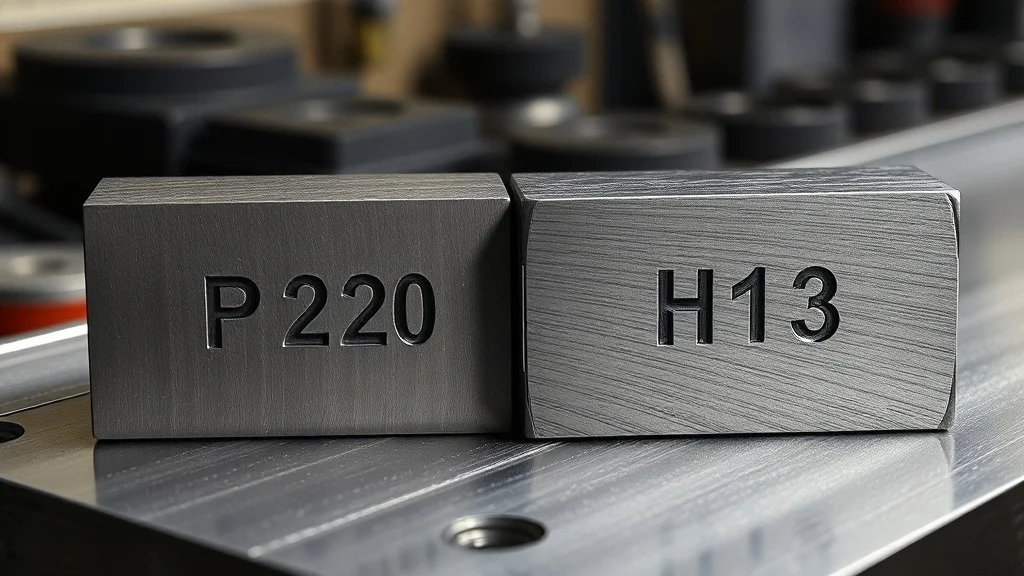
P20 and H13 tool steel — metallurgical comparison
Key Terminology
- Rockwell Hardness (HRC)
- A measure of a material's resistance to permanent indentation. Higher HRC values indicate harder steel, which resists wear and abrasion from glass-filled resins but is more difficult to machine and more susceptible to brittle fracture.
- Pre-Hardened Steel
- Steel that is supplied by the mill already heat-treated to its final hardness. P20 is a pre-hardened steel (28-34 HRC), meaning it can be machined directly without post-machining heat treatment, eliminating the risk of dimensional distortion during hardening.
- Through-Hardened Steel
- Steel that is machined in a soft (annealed) state and then heat-treated to full hardness after rough machining. H13 is typically heat-treated to 44-52 HRC after rough machining, requiring a final finish machining pass after hardening to achieve final dimensions.
- Shot Life
- The number of injection cycles a mold can sustain before requiring significant refurbishment (cavity polishing, core repair, or parting line rework). Shot life is the primary economic driver of tooling steel selection for high-volume programs.
- Thermal Fatigue
- The progressive cracking of a mold surface caused by repeated heating and cooling cycles during injection molding. H13 hot-work steel is specifically formulated to resist thermal fatigue, making it mandatory for high-temperature resins and high-cycle applications.
Side-by-Side Technical Comparison
| Property | P20 Tool Steel | H13 Tool Steel |
|---|---|---|
| Rockwell Hardness (HRC) | 28–34 HRC (pre-hardened) | 44–52 HRC (after heat treatment) |
| Machinability | Excellent — machines in pre-hardened state, no post-HT finish machining required | Moderate — requires finish machining after heat treatment; HSM with carbide tooling |
| Expected Shot Life | 300,000 – 500,000 shots | 1,000,000+ shots |
| Thermal Fatigue Resistance | Moderate — suitable for standard thermoplastics below 300°C melt temp | Excellent — designed for hot-work applications; mandatory for PEEK, PPS, and glass-filled resins |
| Surface Finish Capability | SPI B1 (Ra 0.05μm) maximum without nitriding | SPI A1 (Ra 0.012μm) mirror finish achievable |
| Relative Tooling Cost | Baseline (1.0×) | 1.15× – 1.35× P20 cost |
| Tooling Lead Time | 4–6 weeks (single cavity) | 6–10 weeks (includes heat treatment cycle) |
| Weldability (Repair) | Good — pre-heat to 200°C, TIG weld with P20 filler | Moderate — requires pre-heat to 300°C and post-weld stress relief to prevent cracking |
| Best For | ABS, PP, HDPE, PC — volumes 50k–500k/year | PEEK, PPS, glass-filled resins, 1M+ shot programs, SPI A1 cosmetic parts |
When to Choose P20
P20 is the correct choice for the majority of injection mold tooling programs. Its pre-hardened state eliminates the heat treatment step, reducing tooling lead time by 2-4 weeks and eliminating the risk of dimensional distortion during hardening. For programs processing commodity thermoplastics — ABS, PP, HDPE, PC, and standard Nylon grades — at volumes below 500,000 shots per year, P20 delivers the optimal balance of tooling cost, lead time, and service life.
At our South African facility, a standard single-cavity P20 mold for a medium-complexity consumer product housing (projected area 150cm², 2 side actions) is priced at $8,500-12,000 — compared to $18,000-24,000 at a US contract toolmaker. This 40-55% cost reduction is the core of our tooling cost arbitrage proposition.
When to Choose H13
H13 becomes the technically correct choice — and often the only viable choice — in four specific scenarios. First, when processing high-temperature engineering resins (PEEK at 340-400°C melt, PPS at 300-340°C melt, or Ultem at 340-380°C melt) that would cause thermal fatigue cracking in P20 within 50,000-100,000 shots. Second, when the program requires SPI A1 or A2 mirror surface finish for optical or cosmetic applications — H13 at 48-52 HRC polishes to a lower Ra value than P20 at 30-34 HRC. Third, when annual production volume exceeds 500,000 shots, where the higher tooling cost of H13 is amortized over a longer shot life, reducing the per-part tooling cost below P20. Fourth, when processing glass-filled or mineral-filled resins above 30% filler loading, where the abrasive filler particles erode P20 cavities at a rate 3-5× faster than H13.
Offshore Tooling Cost Comparison
The 40-60% cost arbitrage available through our South African facility applies to both P20 and H13 tooling. The absolute saving is larger for H13 programs because the base tooling cost is higher. A complex 4-cavity H13 hot runner tool for a medical device housing that costs $85,000 at a US Tier 1 toolmaker costs $38,000-42,000 at our facility — a saving of $43,000-47,000 that flows directly to the program's capital budget.
Use our Landed Cost Calculator to model the exact savings for your specific material and volume combination, including the $2,500 LCL sea freight cost from Durban to your US or UK port.
Calculate Your Tooling Steel Savings
Landed Cost Arbitrage Calculator
Compare standard US/UK manufacturing against our quality-assured South African facility.