
Nylon (Polyamide) Injection Molding
When mechanical engineering applications demand exceptional wear resistance, a low coefficient of friction, and high fatigue strength, Nylon (Polyamide) is the industry standard. Our global custom molding company specializes in precision Nylon injection molding for gears, bushings, and automotive under-hood components.
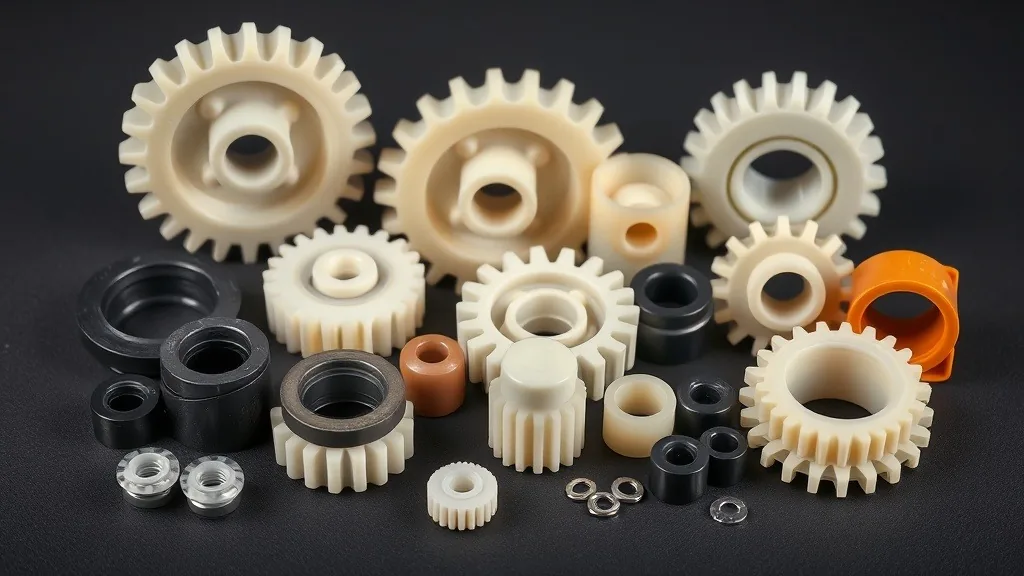
Nylon PA66 injection molded gears and mechanical components — Johannesburg, South Africa
Nylon Material Properties (ASTM Standards)
Nylon (chemically known as Polyamide or PA) is a semi-crystalline engineering thermoplastic. It is available in several formulations, with Nylon 6 (PA6) and Nylon 6/6 (PA66) being the most common for injection molding. The data below represents typical values for unfilled Nylon 6/6 in its conditioned (moisture-equilibrated) state.
| Property | Typical PA66 Value (Conditioned) | ASTM Test Standard |
|---|---|---|
| Density / Specific Gravity | 1.14 g/cm³ | ASTM D792 |
| Tensile Strength at Yield | 55–65 MPa | ASTM D638 |
| Flexural Modulus | 1,200–1,500 MPa | ASTM D790 |
| Izod Impact, Notched | 100–150 J/m | ASTM D256 |
| Mold Shrinkage (Unfilled) | 1.0–2.0% | ASTM D955 |
| Heat Deflection Temp (HDT) at 1.82 MPa | 75–90°C | ASTM D648 |
| Melting Point | 255–265°C | ASTM D3418 |
The Hygroscopic Nature of Nylon
The most critical engineering characteristic of Nylon is its hygroscopic nature. The amide groups in the polymer chain form strong hydrogen bonds with water molecules. This means Nylon acts like a sponge, absorbing moisture from the ambient air until it reaches equilibrium (typically 2.5% to 3.0% by weight at 50% relative humidity).
This moisture absorption fundamentally alters the material's mechanical properties. Water acts as a plasticizer within the Nylon matrix.
- Dry-as-Molded (DAM): Immediately after injection molding, the part is completely dry. In this state, Nylon is highly rigid, possesses maximum tensile strength, but is relatively brittle and susceptible to impact failure.
- Conditioned (50% RH): Once the part absorbs moisture, its tensile strength and stiffness decrease (often by up to 30%), but its impact strength and toughness increase dramatically. The part becomes highly resilient and fatigue-resistant.
Because "dry-as-molded" parts can fracture during assembly or early use, our facility often performs post-mold conditioning. We submerge the freshly molded Nylon components in hot water baths to rapidly accelerate the moisture absorption process, ensuring the parts possess their required toughness before they are shipped to your assembly line.
Self-Lubrication and Wear Resistance
Nylon is the material of choice for kinematic applications—parts that move, slide, or rotate against other surfaces. Its semi-crystalline structure provides an inherently low coefficient of friction and outstanding resistance to abrasive wear.
This "self-lubricating" property allows engineers to design gears, bearings, bushings, and sliding tracks that operate smoothly and quietly without the need for external liquid lubricants (oils or greases). This is particularly advantageous in food processing equipment, textile machinery, and consumer appliances where external lubrication would cause contamination or attract dust and debris. For extreme wear applications, Nylon can be compounded with solid lubricants like PTFE (Teflon) or Molybdenum Disulfide (MoS2) to further reduce friction.
Glass-Filled Nylon and Tooling Implications
While unfilled Nylon is tough and flexible, adding short glass fibers (typically 15% to 33% by weight) transforms it into a highly rigid structural material. Glass-filled Nylon (e.g., PA66-GF30) exhibits massive increases in tensile strength (often exceeding 180 MPa) and pushes the Heat Deflection Temperature (HDT) from 80°C up to an impressive 240°C. This makes glass-filled Nylon an excellent metal-replacement material for automotive under-hood components like intake manifolds and radiator end tanks.
However, glass fibers are highly abrasive. When molding glass-filled Nylon, the high-velocity polymer melt acts like liquid sandpaper as it flows through the mold's sprue, runners, and gates. If a mold is cut from soft aluminum or unhardened P20 steel, the glass fibers will rapidly erode the gate areas and cavity details, destroying the tool's dimensional accuracy within a few thousand shots.
Therefore, when specifying glass-filled Nylon, our engineering team mandates the use of fully hardened tool steels. We typically specify H13 tool steel hardened to 50-54 HRC for the core and cavity blocks to withstand the abrasive wear and guarantee the longevity of the mold.
Calculate Your Nylon Tooling Margin Improvement
Landed Cost Arbitrage Calculator
Compare standard US/UK manufacturing against our quality-assured South African facility.