
Automotive Plastics Manufacturing
The global automotive industry consumes over 14 million tonnes of plastic annually, driven by relentless lightweighting mandates, electrification, and the shift from metal to polymer in structural and functional components. Our global custom molding company delivers automotive injection molding for Tier 1 and Tier 2 suppliers — multi-cavity P20 and H13 steel tooling, PPAP-style documentation, and quality systems compatible with automotive industry requirements at 40-60% below US and UK tooling costs.
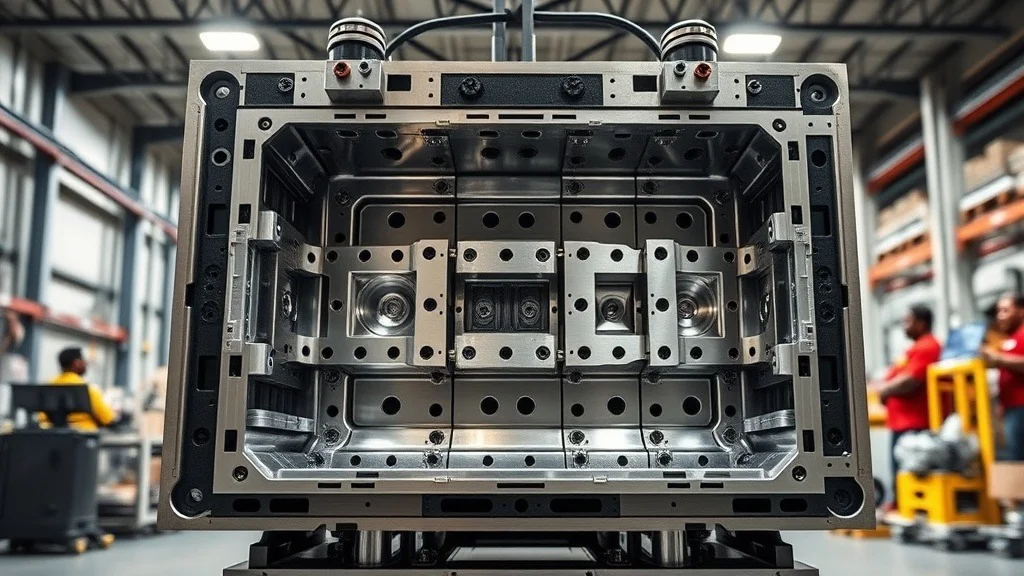
Multi-cavity automotive tooling production — Johannesburg, South Africa
Lightweighting: The Structural Case for Plastic
Automotive lightweighting is no longer a cost-reduction exercise — it is a regulatory mandate. CAFE (Corporate Average Fuel Economy) standards in the US and CO₂ fleet average targets in the EU create a direct financial penalty for every kilogram of excess vehicle mass. For electric vehicles, mass reduction has an even more direct impact: every 100kg of mass reduction extends range by approximately 10-15km on a standard 75kWh battery pack, reducing the battery capacity required to meet range targets and lowering the most expensive component in the vehicle.
Injection-molded glass-fiber-reinforced thermoplastics achieve 40-60% weight reduction versus equivalent steel stampings. A steel door inner panel weighing 8.5kg can be replaced with a 30% glass-filled PP structural panel at 3.8kg — a 4.7kg saving per door, or 18.8kg for a four-door vehicle. At the current automotive industry benchmark of $3-5 per kilogram of mass reduction, this single substitution delivers $56-94 in cost savings per vehicle at the OEM level, before accounting for the secondary savings from reduced suspension, braking, and powertrain loads.
Under-Hood Thermal Resistance Requirements
The engine bay is the most thermally demanding environment in the vehicle. Continuous operating temperatures of 120-150°C, combined with exposure to engine oil, coolant, fuel, and brake fluid, eliminate the majority of commodity thermoplastics from consideration. The following materials form the core of our under-hood offering.
- PA66-GF30 (30% Glass-Filled Nylon 66): Continuous service temperature 130°C dry / 90°C wet. Primary material for engine covers, air intake manifolds, thermostat housings, and cooling fans. Tensile strength 185 MPa, flexural modulus 9,000 MPa.
- PPS (Polyphenylene Sulfide): Continuous service temperature 220°C. Inherently flame-retardant (UL94 V-0 without additives). Primary material for fuel system components, pump housings, and electrical connectors in high-temperature zones.
- PBT-GF30 (30% Glass-Filled Polybutylene Terephthalate): Excellent dimensional stability under thermal cycling. Primary material for electrical connectors, sensor housings, and relay blocks.
- PP-GF40 (40% Glass-Filled Polypropylene): Cost-effective solution for battery trays, cooling system brackets, and underbody shields. HDT at 1.82 MPa: 155°C.
Multi-Cavity Tooling Strategy for High-Volume Programs
Automotive production volumes — typically 50,000 to 500,000 vehicles per year — demand a fundamentally different tooling strategy than consumer product or industrial manufacturing. The economics of automotive tooling are driven by three variables: cavity count, cycle time, and tool life. Optimizing these three variables simultaneously is the core competency that separates a capable automotive molder from a general-purpose contract manufacturer.
For a program requiring 200,000 parts per year with a 45-second cycle time, a single-cavity tool running 24/5 produces approximately 110,000 parts per year — insufficient to meet demand. A 2-cavity tool at the same cycle time produces 220,000 parts per year, meeting demand with a 10% capacity buffer. The incremental tooling cost of the second cavity is typically 25-35% of the first cavity cost, making the 2-cavity tool 60-70% more cost-effective per part than two single-cavity tools.
Our tooling engineers design multi-cavity automotive tools with balanced hot runner systems to ensure identical fill profiles across all cavities, eliminating the dimensional variation between cavities that is the primary quality failure mode in unbalanced tooling. For programs with annual volumes above 500,000 parts, we recommend H13 hot-work steel tooling with a design life of 1,000,000+ shots, amortizing the higher tooling cost over a longer production run.
PPAP Documentation & Automotive Quality
Automotive Tier 1 and Tier 2 suppliers require PPAP (Production Part Approval Process) submission before any new part enters production. Our standard Level 3 PPAP package includes: Design Records, Engineering Change Documentation, Customer Engineering Approval, DFMEA, Process Flow Diagram, PFMEA, Control Plan, Measurement System Analysis (MSA/Gauge R&R), Dimensional Results (minimum 30-piece sample), Material Performance Test Results, Initial Process Capability Study (Cpk ≥ 1.67 on all critical characteristics), Qualified Laboratory Documentation, and a Part Submission Warrant (PSW).
South African Manufacturing: The Tier 2 Arbitrage Opportunity
The automotive supply chain is undergoing a structural reorganization driven by three forces: US-China trade tensions, the CHIPS and Science Act reshoring incentives, and the EU's Carbon Border Adjustment Mechanism. South African manufacturing sits in a uniquely advantageous position in this reorganization. South Africa is a beneficiary of AGOA (African Growth and Opportunity Act), which provides duty-free access to the US market for manufactured goods. The USD/ZAR exchange rate provides a structural 40-55% cost advantage over US domestic manufacturing. And South Africa's established automotive manufacturing sector — BMW, Toyota, Ford, and Isuzu all operate assembly plants in South Africa — means the supplier ecosystem, logistics infrastructure, and technical workforce are already calibrated to automotive quality standards.
Calculate Your Automotive Tooling Savings
Enter your material and annual volume to see the exact landed cost comparison.
Landed Cost Arbitrage Calculator
Compare standard US/UK manufacturing against our quality-assured South African facility.