
ABS Plastic Injection Molding
Acrylonitrile Butadiene Styrene (ABS) is the workhorse of the manufacturing sector. Our global custom molding company specializes in high-tolerance ABS plastic injection molding for structural components, medical device housings, and automotive interiors.
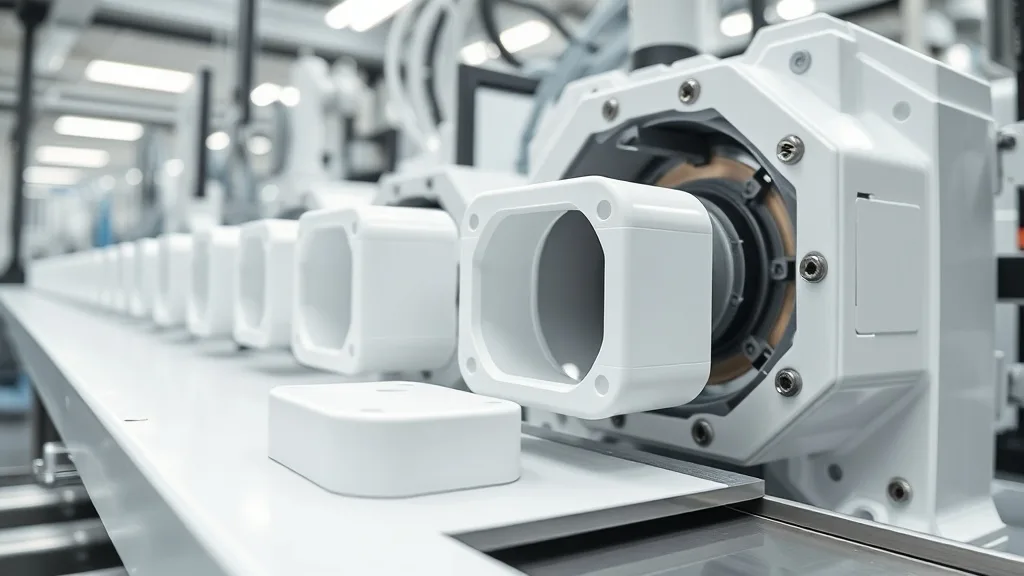
ABS medical device housings on production line — Sandton, South Africa
Why Manufacture ABS Offshore with Us?
ABS requires precise thermal control to prevent warping and manage shrinkage rates (typically 0.4% - 0.8%). Our engineering team conducts rigorous mold-flow analysis to optimize cooling channels and gate sizes specifically for ABS viscosity. By offshoring the heavy tooling costs to our South African facility, you achieve Tier-1 production quality at a fraction of Western costs.
ABS Material Properties (ASTM Standards)
The structural integrity of ABS stems from its three constituent monomers: Acrylonitrile provides chemical and thermal stability, Butadiene delivers toughness and impact strength, and Styrene yields a glossy, rigid surface that is easy to machine and mold. Below are the standard ASTM test values for general-purpose injection molding ABS grades.
| Property | Typical ABS Value | ASTM Test Standard |
|---|---|---|
| Density / Specific Gravity | 1.02–1.05 g/cm³ | ASTM D792 |
| Tensile Strength at Yield | 40–50 MPa | ASTM D638 |
| Flexural Modulus | 2,100–2,400 MPa | ASTM D790 |
| Izod Impact, Notched | 200–400 J/m | ASTM D256 |
| Mold Shrinkage | 0.4–0.8% | ASTM D955 |
| Heat Deflection Temp (HDT) at 1.82 MPa | 85–100°C | ASTM D648 |
ABS Chemical Resistance Profile
When specifying ABS for enclosures or housings, engineers must carefully evaluate the environmental conditions the part will face. ABS offers excellent resistance to aqueous acids, alkalis, and concentrated hydrochloric and phosphoric acids. It also withstands animal, vegetable, and mineral oils.
However, ABS is highly susceptible to attack by certain organic solvents. It will swell, soften, or dissolve when exposed to glacial acetic acid, carbon tetrachloride, aromatic hydrocarbons (like benzene and toluene), chlorinated hydrocarbons, esters, and ketones. For applications requiring exposure to these harsh chemicals, our engineering team typically recommends transitioning to a semi-crystalline polymer like High-Density Polyethylene (HDPE) or Polypropylene (PP).
Wall Thickness Guidelines for ABS Parts
Proper Design for Manufacturability (DFM) is critical to preventing sink marks, voids, and warpage in ABS injection molding. The ideal nominal wall thickness for ABS components ranges from 1.5mm to 3.0mm (0.060" to 0.120").
To maintain structural integrity without inducing sink marks on the cosmetic (A-side) surface, internal ribs should be designed at 50% to 60% of the nominal wall thickness. Furthermore, all internal and external corners must be radiused. A minimum radius of 25% of the wall thickness is recommended to reduce stress concentrations, which can significantly lower the impact strength of the final molded part. Draft angles of 1° to 2° per side are standard, though textured surfaces (like SPI D-3) will require an additional 1° of draft per 0.025mm of texture depth.
Optimal Gating Strategies for ABS Molds
ABS is a highly viscous, amorphous polymer. Unlike highly crystalline materials, it does not have a sharp melting point, but rather gradually softens. This rheological behavior dictates specific gating strategies during tool design.
To prevent jetting, blush marks, and excessive shear stress, gates must be appropriately sized. Edge gates, sub-gates, and hot sprue drops are all compatible with ABS. Gate thickness should generally be 50% to 80% of the part's wall thickness. If the gate is too small, the high shear rate will degrade the polymer chains, leading to splay marks (silver streaking) near the gate and a reduction in the part's overall impact resistance. Our mold flow analysis software simulates these shear rates before steel is cut, ensuring the gate design is optimized for the specific ABS grade selected.
ABS vs. Polycarbonate: When to Switch
Engineers frequently debate between specifying ABS or Polycarbonate (PC) for rigid enclosures. ABS is generally the default choice due to its lower raw material cost, easier processing (lower injection pressures and melt temperatures), and excellent cosmetic finish capabilities.
You should upgrade to Polycarbonate when the application demands optical clarity (PC can be transparent, ABS is naturally opaque), extreme impact resistance (PC is virtually unbreakable), or high-temperature performance (PC has an HDT of ~135°C compared to ABS at ~95°C). For applications requiring a middle ground—such as automotive interior panels or premium medical devices—we frequently mold PC/ABS blends. This alloy combines the high heat distortion and impact strength of Polycarbonate with the superior processability, flow characteristics, and lower cost of ABS.
Common ABS Applications
- Medical Device Housings: Diagnostic equipment enclosures, surgical instrument handles, and laboratory device shells. Medical grades meet ISO 10993 standards.
- Consumer Electronics: Laptop bezels, keyboard frames, remote control housings, and appliance fascias. ABS readily accepts EMI/RFI shielding coatings.
- Automotive: Dashboard components, wheel covers, and interior trim. PC/ABS blends are heavily utilized here for crash safety compliance.
- Industrial Equipment: Control panel housings, electrical enclosures, and power tool bodies requiring drop-resistance.
Calculate Your ABS Tooling Margin Improvement
Landed Cost Arbitrage Calculator
Compare standard US/UK manufacturing against our South African ISO-certified facility.